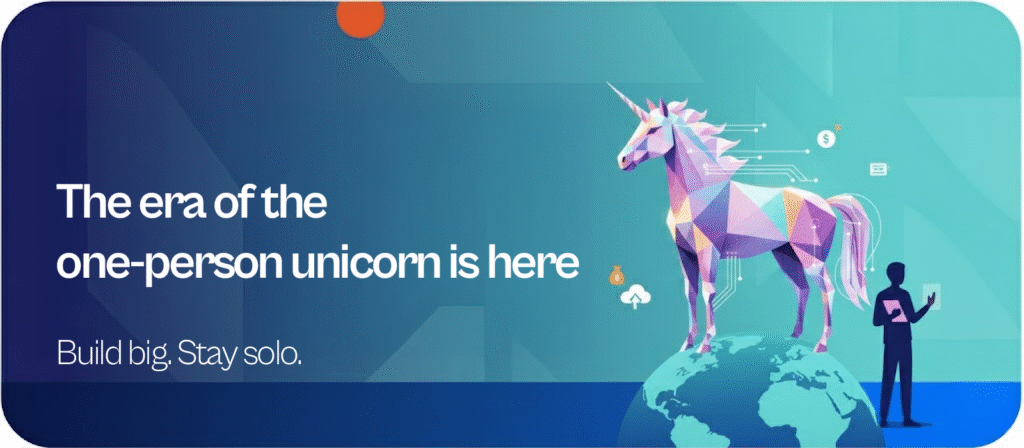
Can one person really build a billion-dollar company? Five years ago, that would have sounded ludicrous. Today, it’s already happening.
The traditional playbook of scaling through human capital is becoming obsolete. A new breed of entrepreneurs is rewriting the rules entirely.
Building with leverage, not labor
From Stardew Valley’s Eric Barone to Pieter Levels of NomadList, to Justin Welsh who turned writing into a $10 million empire, they all share one thing: leverage. But it’s not human leverage anymore. It’s technological sovereignty.
These founders have built independent enterprises powered by AI assistants that execute tasks, platforms that distribute their products globally, and communities that grow exponentially. The “company of one” is no longer just a freelancer. It’s something entirely different.
A new kind of entrepreneur
The math has fundamentally changed. Software, AI agents, automation, and global platforms have removed the boundaries between team size and impact scale. When you remove the constraints of human hiring and organizational complexity, what remains? Pure execution without the overhead.
Let’s dig into what this means. The company of one has evolved from a freelancer into an enterprise capable of operating at unprecedented scale.
The next one-person unicorns won’t just be coders or influencers. They’ll be AI-native founders who train their own AI companions, build digital ecosystems that learn and evolve, and monetize through trust, data, and digital identity.
The intelligence shift
At Aurion, this approach represents a fundamental shift in how we think about building companies. We’re witnessing something bigger than a business trend. This is a civilization-level transformation in how power gets created and distributed.
In the Industrial Age, power belonged to those who controlled machines. In the Information Age, to those who controlled data. In the Age of Intelligence, it belongs to those who control the alignment between human creativity and artificial intelligence.
This isn’t philosophical musing. It’s a practical reality that’s already playing out. We’re not just building companies anymore. We’re building intelligent systems that thrive independently.
Redefining the future of scale
The unicorns of the next decade won’t have 10,000 employees. They’ll have one human, one AI, and infinite potential for growth.
The one-person unicorn isn’t just a new business model. It’s a glimpse into a future where individual independence and technological leverage combine to create entirely new forms of value creation.
The question isn’t whether this will happen. It’s already happening.